Příspěvky

Zobrazují se příspěvky se štítkem John Hope Franklin

"Vzpomínky mé dětství" John Hope Franklin (2005)

Obrázek
John Hope Franklin Afroamerický historik J. H. Franklin (1915–2009) vypráví své zkušenosti s rasovou segregací a rasismem během dětství. V roce 2005 vyšel jeho životopis  „Mirror to America: The Autobiography of John Hope Franklin“ .

"From Slavery to Freedom: A History of the American Negro" John Hope Franklin (Alfred A. Knopf Company, 1947)

Obrázek
foto: "From Slavery to Freedom" John Hope Franklin (Edition 1969) Since its original publication in 1947, From Slavery to Freedom has stood as the definitive his-tory of African Americans. Coauthors John Hope Franklin and Alfred A. Moss, Jr., give us a vividly detailed account of the journey of African Americans from their origins in the civilizations of Africa, through their years of slavery in the New World, to the successful struggle for freedom and its aftermath in the West Indies, Latin America, and the United States. The book deals in considerable detail with the period after slavery, including the arduous struggle for first-class citizenship that has extended into the twentieth century. Many developments in recent African American history are examined, including demographic change; educational efforts; literary and cultural changes; problems in housing, health, juvenile matters, and poverty; the expansion of the black middle class; and the persistence of discrimination...

"The Militant South, 1800–1861" John Hope Franklin (Harvard University Press, 1956)

Obrázek
The Militant South, 1800–1861 John Hope Franklin (1915–2009) Cambridge: Belknap Press of Harvard University Press 1956 (First Edition) A study of the thread of violence that runs through the history of the American South. The book examines militant defenses such as slave laws, hostility toward Native Americans, Southern involvements in Cuba and Nicaragua, dueling, the growth of military schools, etc. Table of Contents 1 Background of Violencepage 2 Fighters' Fatherlandpage 3 Personal Warfarepage 4 A Militant Gentrypage 5 Defending The Cornerstonepage 6 Militant Expansionismpage 7 A Little Learningpage 8 West Points of the Southpage 9 The Citizen Soldierypage 10 Literary and Social Echoespage 11 Toward a Unified Southpage 12 Ready to Fightpage Bibliographical Essaypage

"The Free Negro in North Carolina 1790-1860" John Hope Franklin (University of North Carolina, 1943)

Obrázek
The Free Negro in North Carolina 1790-1860 John Hope Franklin (1915–2009) Chapel Hill: University of North Carolina, 1943 (First Edition) 271pp Franklin’s dispassionate examination of the “legal status of the free Negro, his place in the economic life of the state, his social and religious life.” UNC Press notes: “As Franklin shows, freed slaves in the antebellum South did not enjoy the full rights of citizenship. Even in North Carolina, reputedly more liberal than most southern states, discriminatory laws became so harsh that many voluntarily returned to slavery.” Contents    Foreword  Preface    I. INTRODUCTION  II. GROWTH OF THE FREE NEGRO POPULATION  Numbers and Distribution  Manumission  Miscegenation  Runaway Slaves and Immigrant Free Negroes  Maintaining the Status of a Free Man  III. LEGAL STATUS OF THE FREE NEGRO  The Problem of Discipline  The Free Negro in Court  Citizenship in the Larger Sense  ...

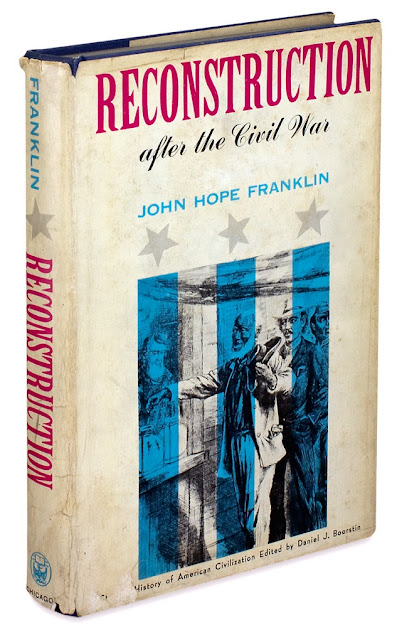
"Reconstruction After the Civil War" John Hope Franklin (The University of Chicago Press, 1961)

Obrázek
Reconstruction After the Civil War John Hope Franklin (1915–2009) The University of Chicago Press 1961 (First Edition) 258pp. Reconstruction after the Civil War explores the role of former slaves during this period in American history. Looking past popular myths and controversial scholarship, John Hope Franklin uses his astute insight and careful research to provide an accurate, comprehensive portrait of the era. His arguments concerning the brevity of the North’s occupation, the limited power wielded by former slaves, the influence of moderate southerners, the flawed constitutions of the radical state governments, and the downfall of Reconstruction remain compelling today. Table of Contents 1. The Aftermath of War 2. Presidential Peacemaking 3. Reconstruction: Confederate Style 4. Confederate Reconstruction Under Fire 5. Challenge by Congress 6. The South’s New Leaders 7. Constitution-making in the Radical South 8. Reconstruction—Black and White 9. Counter Reconstruction 10. Economic ...

"Color and Race" John Hope Franklin (Ed.), Houghton Mifflin Company, 1968

Obrázek
Color and Race John Hope Franklin, Editor (1915–2009) Boston: Houghton Mifflin Company 1968 (First edition) 391 pages Color and Race in the Modern World / Hope Franklin, John Color, the Universal Intellectual Community and the Afro-Asian Intellectual / Shils, Edward Race and Color in International Relations / Gardiner, Robert K.A. Color, Racism and Christianity / Bastide, Roger The Revolt Against Western Values / Mason, Philip Group Identity and Political Change: The role of color and physical characteristics / Isaacs, Harold R. An Outline of the Role of Color in Adaptation Phenomena / Raveau, François The Significance of Skin Color in Human Relations / Gergen, Kenneth J. The Social Perception of Skin Color in Japan / Wagatsuma, Hiroshi Race and Descent as Social Categories in India / Béteille, André Color in Nothern Africa / Brown, Leon Carl Color and Power in the South African Situation / Legum, Colin The "Colored Immigrant" in Britain / Braithwaite, E.R. Some Aspects of Co...

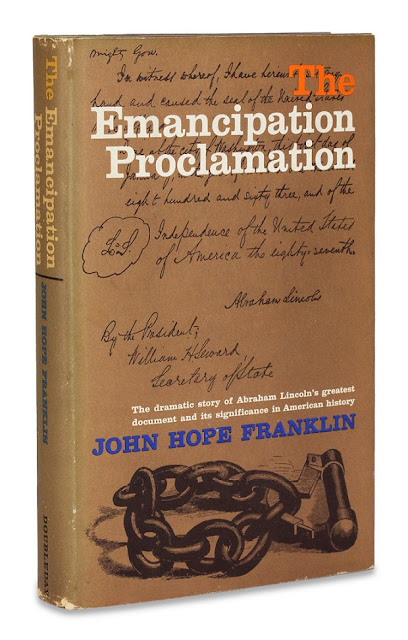
"The Emancipation Proclamation" John Hope Franklin (Doubleday & Company, 1963)

Obrázek
The Emancipation Proclamation John Hope Franklin (1915–2009) New York: Doubleday & Company, Inc. 1963 (First Edition) 181pp Centennial history of Abraham Lincoln’s 1863 Emancipation Proclamation which freed 3.5 million enslaved African Americans. The “evolution of the document in the mind of Lincoln, the circumstances and conditions that led him to make it public [...] its moral and humanitarian significance for contemporary as well as later generations Table of contents Prologue: Time of Decision 1. The Precedents and the Pressures 2. The Decision and the Writing 3. The Hundred Days 4. Day of Days 5. Victory More Certain Epilogue: End of Unrequited Toil

„Mirror to America: The Autobiography of John Hope Franklin“ John Hope Franklin (Farrar, Straus and Giroux, 2005)

Obrázek
John Hope Franklin lived through America's most defining 20th-century transformation, the dismantling of legally-protected racial segregation. A renowned scholar, he has explored that transformation in its myriad aspects, and he was, and remains, an active participant. Born in 1915, he could not but participate: evicted from whites-only train cars, confined to segregated schools, and threatened--once with lynching. And yet he managed to receive a Ph.D. from Harvard. He has become one of the world's most celebrated historians and reshaped the way African American history is understood and taught. But Franklin's participation was much more fundamental than that. From his effort in 1934 to hand President Roosevelt a petition, whether aiding Thurgood Marshall's preparation for Brown v. Board in 1954, marching to Montgomery in 1965, or testifying against Robert Bork's nomination to the Supreme Court in 1987, Franklin has pushed the national conversation on race towards...